
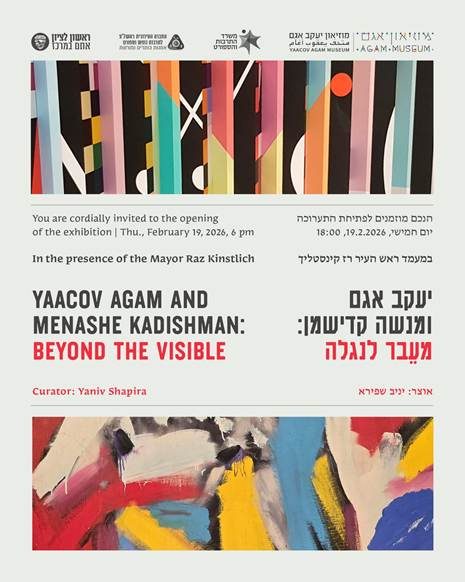
תערוכה חדשה במוזיאון אגם
יעקב אגם ומנשה קדישמן : מעבר לנגלה
אוצר: יניב שפירא
19.2.26 – 30.7.26
התערוכה של יעקב אגם ומנשה קדישמן, בגלריה העליונה לתערוכות מתחלפות במוזיאון אגם, מפגישה בין שני ענקים באמנות הישראלית. מפגש ראשון ויוצא דופן בין שני זרמים מנוגדים, בין יעקב אגם שהממד הרוחני של המסורת היהודית היווה מקור השראה לכלל יצירתו, לבין מנשה קדישמן, שקידש את החילוניות והעמיד בבסיס יצירתו, שאלות של אחריות, חברה ומוסר.
הצגתם זה לצד זה, בתערוכה תחת הכותרת "מעבר לנגלה", יוצרת דיאלוג אמנותי מרתק ומפתיע וחושפת את המשותף ביצירותיהם האייקוניות
האמנים יעקב אגם ומנשה קדישמן, הם כמו שני ענפים שצמחו משורש המסורת היהודית והתרבות הישראלית, הם בני אותה שכבת גיל, עולמם עוצב במקביל לכינונה של המדינה, שניהם חתני פרס ישראל, ויצירתם זכתה להכרה מקומית ובינלאומית.
התערוכה המשותפת הראשונה שלהם במוזיאון אגם ראשון לציון, מבליטה שתי תפיסות עולם שונות, ומציעה שתי אופציות אמנותיות שונות. בה בעת, התערוכה מחדדת גם את המקום המרכזי המשותף ליצירתם – נוף, טבע, שפה וסמלים יהודיים וישראלים. הצגתם יחד, מזכירה לנו את כוחה המעורר של אמנות במיטבה, לפעול על החושים ועל המחשבה.
יעקב אגם (נ' 1928), ממייסדי זרם האמנות הקינטית, מציב במרכז יצירתו תנועה, הפשטה וצבעוניות עשירה. את הביטוי להתפתחות ולשינוי התמידיים, הוא מקביל למציאות שמשתנה ללא הרף, ושואף ליצירה שתתגלה שלבים שלבים. הפסל מעבֶר (beyond) שבמרכז התערוכה הנוכחית , סובב סביב צירו ,כך שניתן לראותו מכל צדדיו ומתוך כמה זוויות ראייה. תנועתו וצבעוניותו, מאזכרים את המעבר מהשקט של הלילה להמולת היום, או את התנועה המחזורית של עונות השנה.
מנשה קדישמן (2015-1932), היה רועה צאן בצעירותו, דבר שהשפיע מאד על יצירתו. ציורי הכבשים הפכו לסימן ההיכר שלו וקיבלו פרשנות אקטואלית לאור האתוס הישראלי. כאשר ייצג את ישראל בביאנלה בוונציה ב-1978, אשר הוקדשה לאמנות כטבע. הוא הסב את הביתן הישראלי לדיר ובו שמונה-עשרה כבשים, בו הוא שימש רועה צאן והוציא את עדרו למרעה בשטח הביאנלה. על גב הכבשים הוא צייר כתמים בצבע כחול, פעולה שתיאר בדיעבד, כניסיון ליצור "ציור קינטי" .
Agam and Kadishman: Beyond the Visible
The exhibition “Yaacov Agam and Menashe Kadishman: Beyond the Visible” brings together two giants of Israeli art. Both are of the same age, their worlds were shaped in parallel with the establishment of the State of Israel, and their work has gained extensive local and international recognition. Agam embraced the spiritual dimension of Jewish tradition as a source of inspiration; Kadishman sanctified secularism and placed questions of responsibility, society, and morality at the center of his work. Their presentation side by side highlights two contrasting currents in Israeli art, while emphasizing the centrality of landscapes, nature, language, and symbols – both Jewish and Israeli – in the oeuvre of both artists.
Yaacov Agam (b. 1928) places movement, abstraction, and a riche palette at the center of his work, in a manner consistent with his religious beliefs. In his text “Paintings in Motion” (1962), he lists these aspects of his work as as attempts to break free from the statis of traditional painting: “My aspiration was to create a type of painting that exists not only
in space, but also in time, in which it develops and changes.” He equates the visual expression of constant development and change with a reality in a state of constant flux, and strives to create works that are gradually revealed. This idea is clearly evident in the work Beyond at the center of this exhibition – a sculpture that revolves around its axis so that it can be viewed from all sides and from several angles. The sculpture's movement and colors evoke the transition from the quiet of the night to the bustle of the day, as well as the cyclical movement of the seasons: on its one side are daytime shades of white and yellow; on the other, a black background with white shapes and an orange circle resembling a setting sun; between them is a gradual shifting of formal compositions and a rich range of colors.
In 1978, Menashe Kadishman (1932–2015) was invited by the curator Amnon Barzel to represent Israel at the Venice Biennale, which was dedicated to the relationship between art as nature and nature as art. The Israeli pavilion was converted into a sheepfold housing
18 sheep, and Kadishman, serving as a shepherd, taking his flock out to graze on the Biennale grounds. He painted blue spots on the backs of the sheep, an action he later described as an attempt to create a “kinetic painting” in which the spots create different colored compositions. Kaddishman devoted the following years mainly to painting, which was characterized by momentum and creative freedom. His paintings centered the heads of
sheep and shepherds (men and women), which also received a contemporary interpretation in light of the Israeli ethos being constructed at the time. At the foot of some of the large canvases, he placed stones painted green, yellow, pink, black, and blue, creating an illusion of depth. The painting seemed to invade the space and transformed the represented image
into an installation in which the sheep follow the stones, or into a kind of three-dimensional picture in which the shepherd sits at the foot of the stones.
מוזיאון אגם, רחוב מיש"ר 1, ראשון לציון yama.co.il
שני – רביעי 14:30-10:00 חמישי – 20:00-16:00 שישי ושבת – 14:30-10:00